DCR vs Non-DCR Solar Panels in India: Latest Rules and Key Differences
India’s solar energy sector is evolving rapidly, supported by government initiatives, domestic manufacturing and changing regulations. For homeowners, businesses and solar project developers, understanding the difference between Domestic Content Requirement (DCR) and non-DCR solar panels is essential when selecting a solar installation.
While DCR panels are mandatory under certain government-supported schemes, non-DCR panels suit projects where domestic content requirements don’t apply. The right choice depends on scheme eligibility, project requirements, budget and applicable regulations.
What Are DCR and Non-DCR Solar Panels?
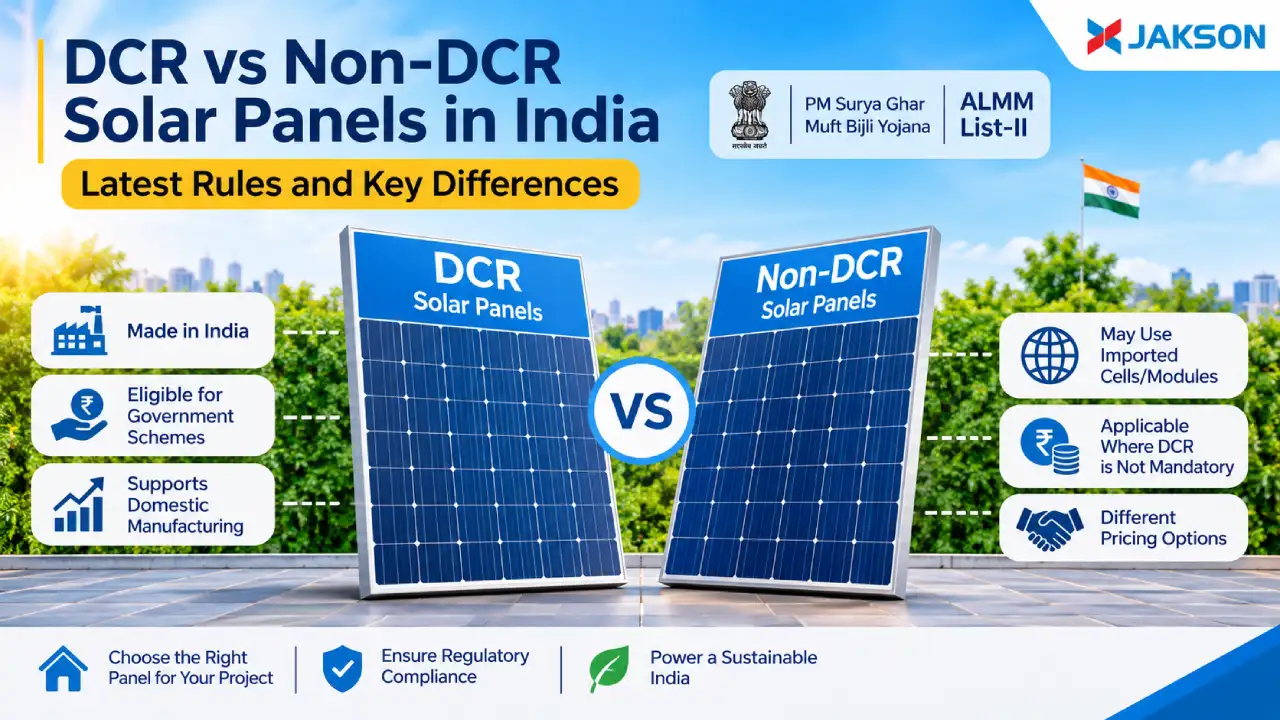
DCR solar panels are manufactured using solar cells and modules produced domestically in India, in accordance with the applicable Domestic Content Requirement guidelines. They support India’s domestic solar manufacturing ecosystem and are required under specified government schemes.Non-DCR solar panels do not meet the applicable domestic content requirements, typically because their cells or modules are sourced from outside India. They may be used in projects where DCR is not mandatory, subject to applicable government regulations and procurement conditions.
DCR vs Non-DCR Solar Panels: Key Differences
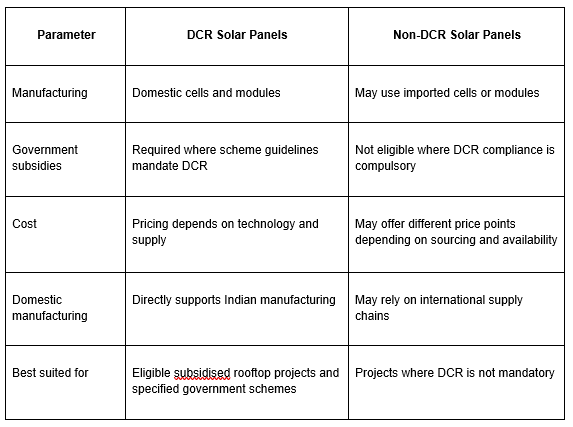
The cost difference is not fixed. Buyers should compare complete system costs, including installation, inverters, mounting structures, warranties and after-sales service, rather than choosing panels on price alone.
Latest Government Updates on DCR and Solar Panel Regulations
India’s solar procurement framework includes both DCR requirements and the Approved List of Models and Manufacturers (ALMM). These are related to domestic manufacturing but serve different purposes.
1. ALMM List-II requirements for solar cells
The Ministry of New and Renewable Energy (MNRE) introduced ALMM List-II for solar PV cells, with applicability commencing on 1 June 2026 under the notified framework. The requirements affect the sourcing of solar cells for covered projects and are intended to strengthen domestic manufacturing.
On 8 October 2026, MNRE issued the 12th revision of ALMM List-II, reflecting continuing developments in India’s approved solar cell manufacturing ecosystem. MNRE
MNRE has also clarified that there is no blanket extension beyond the original deadline, although certain eligible projects may receive case-specific relief. A limited window through 31 December 2026 applies to specified net-metering and open-access renewable energy projects under the relevant orders. Project developers should verify their eligibility before procurement. MNRE current notices
2. DCR compliance under PM Surya Ghar
The PM Surya Ghar: Muft Bijli Yojana requires DCR-compliant solar modules for installations claiming the applicable central financial assistance. This means both the solar cells and modules must meet the scheme’s domestic manufacturing requirements.
A limited exception applies to eligible residential consumers who opt to forgo central financial assistance through the scheme’s “Give It Up” option. Such consumers may use non-DCR modules under the applicable provisions, currently specified through 31 March 2027. They must still follow the prescribed application and installation process. Ministry clarification reported by Economic Times
DCR and ALMM compliance should not be treated as interchangeable. A panel’s eligibility depends on the specific scheme, applicable lists and project conditions.
3. Verification of DCR credentials
The National Institute of Solar Energy (NISE), under MNRE, operates a DCR verification portal to support traceability of domestically manufactured solar cells and modules. Buyers and installers should confirm that the relevant product credentials can be verified where required
Which Solar Panels Should You Choose?
The choice between DCR and non-DCR panels depends on the project’s purpose and applicable requirements.
- Residential rooftop installations: If you intend to claim eligible PM Surya Ghar assistance, select compliant DCR modules. If you plan to forgo assistance, verify the conditions under which non-DCR modules are permitted.
- Commercial and industrial projects: Assess the applicable ALMM requirements, procurement specifications, financing conditions and project approvals before finalising the modules.
- Utility-scale projects: Evaluate domestic content obligations, tender conditions, approved manufacturers, delivery schedules and long-term performance requirements.
Before placing an order, confirm the latest MNRE notifications and scheme guidelines. Regulatory compliance at the procurement stage can help prevent delays, rejected documentation and unexpected project costs.
How Jakson Supports India’s Solar Transition
As India expands its domestic solar manufacturing and renewable energy infrastructure, manufacturers and solution providers play an important role in meeting the requirements of different customer segments.
Jakson offers solar modules, including its Helia MonoPERC monofacial and HeliaPlus MonoPERC bifacial product ranges, alongside rooftop solar EPC solutions. Customers should confirm the current model specifications, certifications, availability and DCR eligibility directly with Jakson before selecting a product for a scheme-linked installation.
For homeowners, businesses and project developers, understanding DCR and non-DCR requirements is an important first step towards making an informed solar investment.
DCR and non-DCR solar panels serve different project needs, and neither is universally the better option. DCR panels are essential wherever domestic content rules apply, while non-DCR panels may be suitable for projects outside those requirements.
With India’s solar regulations continuing to evolve, buyers should prioritise compliance, product quality, system performance and lifecycle value. Choosing the right panel can help ensure a smoother installation and a more reliable transition to solar energy.
Frequently Asked Questions (FAQs)
1. What is the main difference between DCR and non-DCR solar panels?
DCR panels use domestically manufactured solar cells and modules in accordance with applicable requirements. Non-DCR panels do not meet those domestic content conditions.
2. Are DCR solar panels mandatory under PM Surya Ghar?
DCR-compliant modules are required for installations claiming applicable central financial assistance under PM Surya Ghar, subject to the scheme guidelines and notified exceptions.
3. Can non-DCR panels be used for residential rooftop solar?
Yes, where permitted by the applicable rules. A limited provision allows eligible residential consumers who forgo central financial assistance under the “Give It Up” option to use non-DCR modules through 31 March 2027. Check the latest official guidelines before installation.
4. Are DCR solar panels more expensive than non-DCR panels?
Not necessarily in every case. Prices depend on technology, capacity, availability, supplier and installation costs. Compare quotations for equivalent systems.
5. What is ALMM List-II?
ALMM List-II is MNRE’s approved list for solar PV cells. Its requirements apply to covered projects and are distinct from DCR obligations under individual government schemes.
6. How can I verify whether a solar module is DCR-compliant?
Use the NISE DCR Verification Portal and confirm the module’s credentials with the supplier or installer where verification is required.
7. Does Jakson offer DCR solar panels?
Jakson has solar module offerings, but buyers should confirm the current model-specific DCR status, documentation and eligibility directly with Jakson before purchasing for a government-supported scheme.