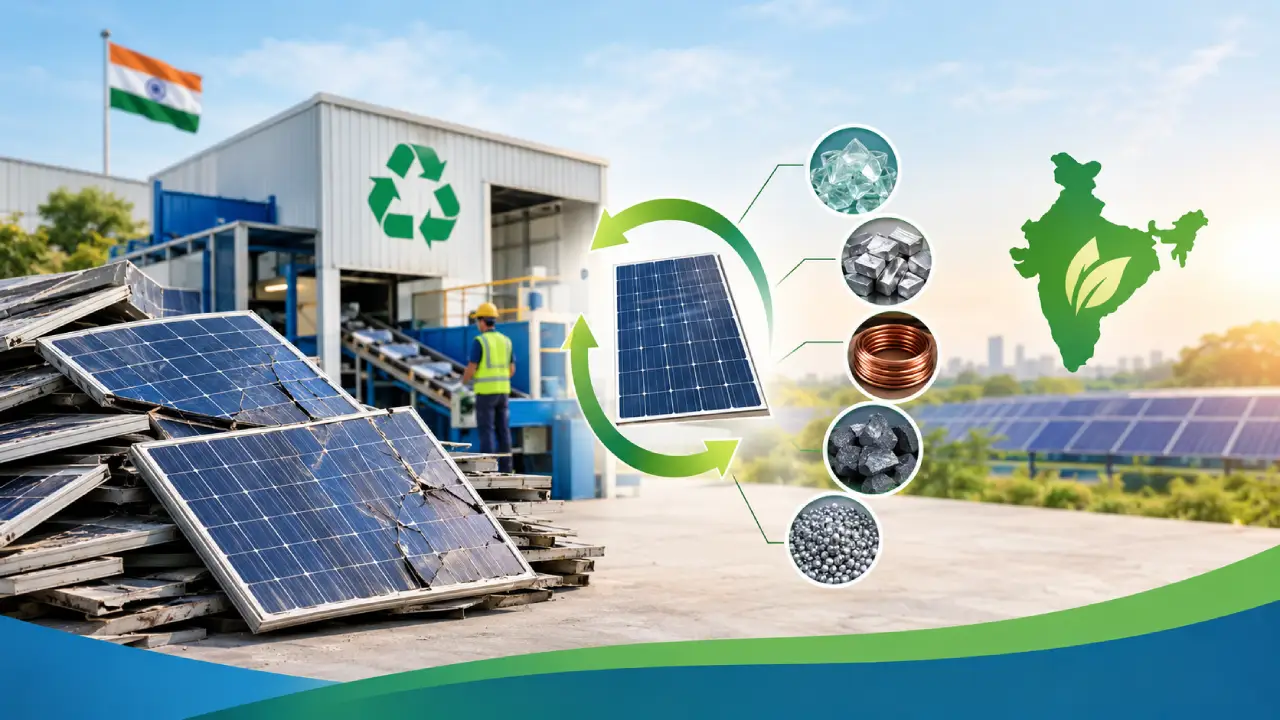
Solar panel recycling in India is the process of collecting damaged and end-of-life solar modules and recovering materials such as glass, aluminium, copper, silicon and silver through mechanical or chemical treatment. It currently costs an estimated ₹883–₹1,079 per module, according to a 2025 CEEW assessment. It matters because India’s solar waste could reach about 600 kilotonnes by 2030. Under Chapter V of the E-Waste (Management) Rules, 2022, in force since 1 April 2023, producers, manufacturers and recyclers share responsibility for managing it, and CPCB issued storage and handling guidelines in March 2026. Solar developers, manufacturers and project owners should start planning now.
Recycling can recover valuable materials, but the economics remain challenging because collection, transportation, processing and equipment require significant investment.
As India expands its solar energy capacity, managing damaged, discarded and end-of-life solar panels is becoming an increasingly important part of the renewable energy transition.
Solar panels are designed to generate electricity for decades. However, modules may need to be replaced earlier because of damage, manufacturing defects, performance degradation or changes in project requirements. Eventually, even functioning panels reach the end of their useful life.
The challenge is not simply to dispose of these panels safely. It is to recover their valuable materials, develop viable recycling infrastructure and establish a system that supports the circular use of resources. India has begun addressing this challenge through its E-Waste (Management) Rules, 2022, and initiatives supporting domestic recycling capacity. Understanding the costs, regulations and available recycling methods is essential for solar developers, manufacturers, project owners and businesses planning for the long-term management of photovoltaic (PV) waste.
Key takeaways
- Cost: Recycling costs an estimated ₹883 (mechanical) to ₹1,079 (chemical) per module, based on CEEW’s 2025 modelling.
- Rules: Solar PV waste is covered by Chapter V of the E-Waste (Management) Rules, 2022. Producers must store solar waste generated up to 2034–35.
- Materials: Glass, aluminium, copper, silicon and silver can be recovered, depending on the recycling process.
- Challenge: Buying back waste modules is the largest recurring cost (56–68%), and formal recycling is currently loss-making.
- Action: Keep module records, separate damaged panels and work only with authorised recyclers.
Why Is Solar Panel Recycling Important in India?
Solar panel recycling is important in India because rapid solar deployment will produce large volumes of discarded modules, while recycling can recover valuable materials and support a circular economy.
An MNRE-supported CEEW estimate, shared in a Rajya Sabha reply in March 2026, projects that cumulative waste from existing and projected solar installations could reach approximately 600 kilotonnes by 2030. The estimate highlights the importance of preparing recycling infrastructure before waste volumes increase substantially. Source: Ministry of New and Renewable Energy, March 2026
Several factors make solar panel recycling important.
1. Managing end-of-life solar modules
Solar panels have long operating lives, but they are not permanent infrastructure.
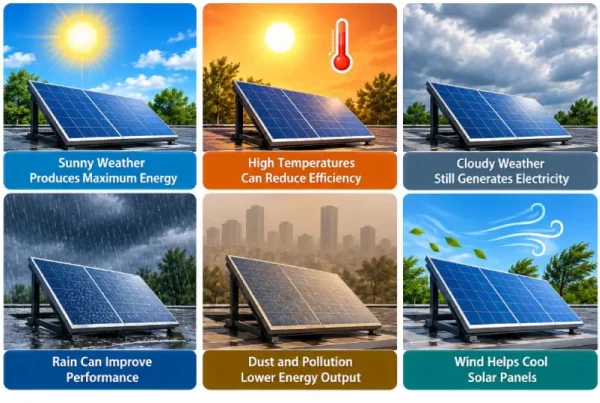
Modules may become unsuitable for continued operation because of physical damage, electrical faults, degradation or replacement during repowering and plant upgrades. Heat, humidity, dust and extreme weather can also accelerate wear, as explained in our guide on how weather conditions impact solar panel performance.
As solar installations mature, the industry must establish ways to collect, transport, store and process these modules responsibly.
2. Recovering valuable raw materials
A typical crystalline silicon solar module contains several materials that can potentially be recovered:
- Glass, which forms the protective front layer.
- Aluminium, commonly used in the module frame.
- Silicon, used in photovoltaic cells.
- Copper, found in electrical connections and conductors.
- Silver, used in cell metallisation.
- Polymers and other components that require appropriate treatment.
Recovering these materials can reduce the need for virgin raw materials and support domestic supply chains. The economic value of recycling depends on the quantity, purity and market price of recovered materials, as well as the cost of processing the discarded module.
3. Supporting a circular solar economy
A circular economy aims to keep materials in productive use for as long as possible, reducing waste and the demand for newly extracted resources.
Solar panel recycling can contribute to this approach by recovering materials for use in manufacturing and other industries.
However, recycling is only one part of the circular economy. Extending the useful life of functioning modules, repairing suitable equipment and improving product design can also reduce waste generation.
How Are Solar Panels Recycled in India? (Step-by-Step Process)
Solar panels are recycled in four stages: collection and inspection, safe handling and dismantling, mechanical recycling, and, where needed, chemical or advanced material recovery. The exact process depends on the module technology, condition, recycling facility and materials targeted for recovery.
Step 1: Collection and inspection
Discarded panels are collected from solar installations, warehouses, manufacturing facilities or other authorised sources.
Before processing, the modules are assessed to determine their condition, composition and suitability for reuse, refurbishment or recycling. Where a panel remains functional and safe, extending its useful life may be preferable to immediate recycling.
Step 2: Safe handling and dismantling
The module is prepared for processing, with components such as the aluminium frame and junction box separated where the recycling process allows.
Solar panels contain bonded layers of glass, encapsulant, photovoltaic cells and backsheet materials. Separating these layers is one of the major technical challenges in recycling.
Appropriate handling and storage are important to avoid breakage, material contamination and environmental risks.
Step 3: Mechanical recycling
Mechanical recycling uses physical processes such as dismantling, crushing, grinding and separation to recover materials.
Depending on the process, it can recover aluminium, glass, copper and silicon-containing fractions.
Mechanical recycling is comparatively established and avoids some of the additional chemical processing requirements of more complex recovery methods. However, recovered materials may contain impurities, which can limit their value and suitability for high-grade manufacturing applications.
Step 4: Chemical and advanced material recovery
Chemical recycling combines physical separation with chemical or thermal treatment to recover selected materials.
More advanced processes may target higher-purity silicon, silver and other valuable components.
These processes can increase material recovery and improve the quality of recovered outputs, but they may also require additional equipment, chemicals, energy and waste-treatment systems.
The appropriate recycling technology depends on the module type, available waste volumes, local infrastructure and the intended market for recovered materials.
How Much Does Solar Panel Recycling Cost in India?
Solar panel recycling in India costs an estimated ₹883 per module (₹4.11 per watt) for mechanical recycling and ₹1,079 per module (₹5.02 per watt) for chemical recycling, according to CEEW’s 2025 assessment.
Solar panel recycling costs depend on module size, technology, collection distance, facility capacity, processing methods and the value of recovered materials.
A 2025 CEEW assessment estimated the following recurring recycling costs for two modelled recycling pathways in India.

These estimates are based on the study’s modelled costs and assumptions. They are not fixed market prices or quotations for every solar panel recycling service. Actual costs may differ depending on the facility, module type, transport arrangements and prevailing material prices.
Source: CEEW, How Much Does It Cost to Recycle a Solar Module in India?
What contributes to recycling costs?
The main cost components include:
1. Waste module procurement
Recyclers may need to pay to acquire discarded modules. CEEW’s analysis identified module procurement as the largest share of recurring costs in its modelled recycling pathways, at 56–68%.
The economics can improve if modules are available at lower acquisition costs or through more efficient collection arrangements.
2. Collection and transportation
Solar installations may be distributed across different states and locations, while recycling facilities may be concentrated in specific industrial regions.
Transport costs depend on distance, module quantity, handling requirements and logistics infrastructure.
3. Processing and labour
Recycling facilities require equipment, trained workers, electricity, maintenance and operational controls.
Chemical recovery pathways may incur additional expenses associated with chemicals, process equipment and residual-waste management.
4. Facility investment and compliance
Establishing a recycling facility requires investment in land, buildings, machinery, safety systems and environmental compliance.
These capital costs affect the overall viability of the recycling business, especially when waste volumes are still developing.
Can solar panel recycling become profitable in India?
Not yet in a formal setup, but the economics can improve. CEEW found that formal solar module recycling is currently financially unviable, with recyclers facing losses of roughly ₹10,000–₹12,000 per tonne. It estimates that profitability would need lower module procurement costs (below about ₹330 per module) or support such as EPR certificate trading, tax incentives and R&D investment.
Solar panel recycling can become more economically attractive as collection networks improve, processing technologies mature and the value of recovered materials increases.
CEEW’s assessment highlights the importance of reducing module procurement and transportation costs, improving material recovery and developing policy mechanisms that support recycling. The financial viability of a recycling project should therefore be evaluated using actual waste volumes, material composition, logistics, processing capacity and expected revenues, not only the price of recovered glass or metal.
What Are the Solar Panel Recycling Regulations in India?
Solar panel recycling in India is regulated under Chapter V of the E-Waste (Management) Rules, 2022, which came into effect on 1 April 2023. CPCB issued guidelines for the storage and handling of waste solar PV modules, panels and cells in March 2026.
The rules include specific provisions for solar photovoltaic modules, panels and cells. Their requirements differ in important respects from the standard extended producer responsibility (EPR) framework that applies to other categories of electronic waste.
1. Registration and inventory requirements
Manufacturers and producers of solar PV modules, panels and cells are required to register on the designated portal and maintain a distinct inventory of solar waste.
They must also file prescribed annual returns and follow applicable procedures and CPCB guidelines.
These requirements help establish traceability and improve visibility into the generation and management of solar PV waste.
2. Storage of solar PV waste
Under Chapter V, producers are required to store solar PV waste generated up to 2034–35 in accordance with CPCB guidelines.
In March 2026, CPCB issued guidelines for the storage and handling of waste solar photovoltaic modules, panels and cells. These provide a framework for managing solar waste safely while the recycling ecosystem develops.
The requirements should be checked against the current CPCB guidance and any subsequent amendments before a project establishes its storage and handling procedures.
Source: CPCB E-Waste Management Portal
3. Material recovery by recyclers
The rules provide for material recovery from solar PV waste in accordance with CPCB requirements.
Recycling facilities must follow applicable registration, environmental and operational requirements. Project owners should verify that their chosen service provider is appropriately authorised for the waste being handled.
4. How does EPR apply to solar panels?
Extended producer responsibility is a regulatory approach under which producers are responsible for managing the waste associated with their products.
For many categories of electronic waste, the E-Waste Rules establish recycling targets and EPR certificate mechanisms.
Solar PV modules, panels and cells have specific provisions. Under the framework described in Chapter V and the applicable schedules, standard EPR recycling targets are not currently prescribed for solar PV waste in the same way as for other covered electronic equipment.
This is an important distinction: solar waste is included in the rules, but its obligations and implementation pathway are not identical to those of other e-waste categories.
Regulatory requirements may evolve as India’s solar waste volumes grow. Manufacturers, project owners and recyclers should consult the latest CPCB portal, notifications and applicable legal provisions before making compliance decisions.
Reference: E-Waste (Management) Rules, 2022
What Materials Can Be Recovered from Solar Panels?
Solar panels can yield glass, aluminium, silicon, copper, silver and polymers, but the materials recovered depend on the panel’s technology, construction and recycling process.
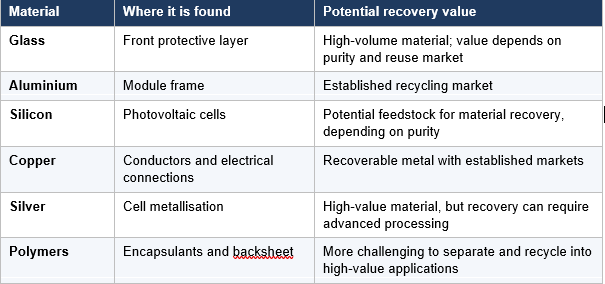
Recovering these materials can support resource efficiency, but not every recycling facility can recover all components at the same quality level.
The ability to recover high-purity materials is particularly important for improving the commercial value of recycled outputs.
What Is the Future of Solar Panel Recycling in India?
India’s solar recycling ecosystem is still developing, and its growth will depend on rising waste volumes, better recovery technology, supportive policy and demand for recovered materials.
Growing waste volumes will create demand for recycling infrastructure
As solar installations mature, the quantity of discarded modules is expected to increase. CEEW projects that India could generate about 11 million tonnes of cumulative solar waste by 2047, which would require nearly 300 recycling plants and an estimated ₹4,200 crore of investment.
Planning collection systems, storage facilities and recycling capacity in advance can help avoid unmanaged waste and reduce logistical challenges.
Domestic material recovery could support manufacturing
Recycled materials may contribute to domestic supply chains for solar module manufacturing and reduce dependence on imported raw materials. CEEW estimates that recovered materials could meet up to 38% of the sector’s manufacturing inputs by 2047.
However, their suitability for manufacturing depends on quality, purity, consistency and the economics of processing.
Technology innovation can improve recovery
Research into better separation methods, chemical recovery, recycling equipment and circular product design may improve the quantity and quality of materials recovered from solar modules.
Developing commercially viable technologies will be important for creating a sustainable recycling industry.
Policy and market development will influence investment
Clearer rules, reliable waste collection, suitable recycling infrastructure and demand for recovered materials can improve investor confidence.
The future growth of the sector will depend on coordinated action by policymakers, solar manufacturers, project developers, recyclers and material buyers.
How Can Solar Project Owners Prepare for End-of-Life Solar Panels?
Solar project owners can prepare by keeping module records, separating damaged panels, checking reuse options and appointing authorised recyclers, well before modules reach the end of their useful life.
Practical steps include:
- Maintain records of installed modules, specifications, serial numbers and replacement history.
- Identify damaged, defective or end-of-life modules separately from functioning equipment.
- Assess whether suitable modules can be repaired, reused or refurbished before recycling.
- Establish safe handling, temporary storage and transportation procedures.
- Verify the registration and authorisation status of recycling service providers.
- Review applicable CPCB requirements and maintain relevant documentation.
- Evaluate recycling arrangements as part of long-term project operations and decommissioning planning.
These steps can help project owners improve traceability, reduce unmanaged waste and prepare for changing regulatory and market conditions.
Building a Circular Future: Solar PV Waste Management in India
Solar energy plays an important role in India’s clean energy transition, but the sustainability of the sector also depends on how materials are managed throughout the life cycle of solar installations.
Solar panel recycling can recover valuable resources, reduce waste and support a more circular approach to renewable energy infrastructure.
At the same time, recycling economics remain dependent on collection costs, processing technologies, material recovery rates and the development of appropriate regulatory and market mechanisms.
As India expands its solar capacity, the next phase of the transition will involve not only generating clean electricity, but also building the systems needed to manage solar equipment responsibly from installation to end of life.
For the solar industry, responsible PV waste management is an opportunity to strengthen resource efficiency, improve lifecycle planning and support the long-term sustainability of renewable energy.
Planning a solar project with the full life cycle in mind? Explore JAKSON Green’s renewable energy solutions or contact the JAKSON team to discuss your requirements.
Frequently Asked Questions
1. Can solar panels be recycled in India?
Yes. Solar panels can be recycled in India, and solar PV waste is covered by the E-Waste (Management) Rules, 2022. Recycling processes can recover materials such as glass, aluminium, copper, silicon and silver, depending on the technology and facility.
2. How much does it cost to recycle a solar panel in India?
Recycling a solar panel in India costs an estimated ₹883 per module for mechanical recycling and ₹1,079 per module for chemical recycling, according to a 2025 CEEW assessment. Actual costs vary with module size, collection, processing and the recycling facility.
3. What happens to old solar panels?
Old solar panels may be assessed for continued use, repair, refurbishment or recycling. Panels that are no longer suitable for use can be dismantled and processed to recover materials, with remaining components managed according to applicable requirements.
4. Which regulations govern solar panel recycling in India?
Solar PV modules, panels and cells are covered by Chapter V of the E-Waste (Management) Rules, 2022. The framework includes registration, inventory, annual reporting, storage and material recovery requirements, supported by CPCB’s March 2026 storage and handling guidelines. Businesses should consult the latest CPCB guidance and applicable amendments.
5. Is there an EPR recycling target for solar panels in India?
Not currently in the same way as for other e-waste. Solar PV waste has specific provisions under the E-Waste Rules, and standard EPR recycling targets are not prescribed for solar PV modules, panels and cells under the applicable framework. Regulatory requirements may evolve, so the latest official provisions should be checked.
6. Which materials are recovered from solar panels?
Depending on the module and recycling process, recoverable materials include glass, aluminium, copper, silicon and silver. Recovery rates and material purity vary across recycling technologies.
7. Why is solar panel recycling still economically challenging?
Recycling can involve substantial costs for acquiring discarded modules, collecting and transporting them, processing the materials and operating compliant facilities. Module procurement alone accounts for 56–68% of recurring costs in CEEW’s modelling, and the financial outcome also depends on the market value and quality of recovered materials.
Disclaimer: This article is an industry explainer, not legal or financial advice. Cost estimates are drawn from CEEW’s 2025 study and regulatory details reflect official CPCB and MoEFCC provisions as of October 2026. Please check the latest CPCB notifications before making compliance or investment decisions.