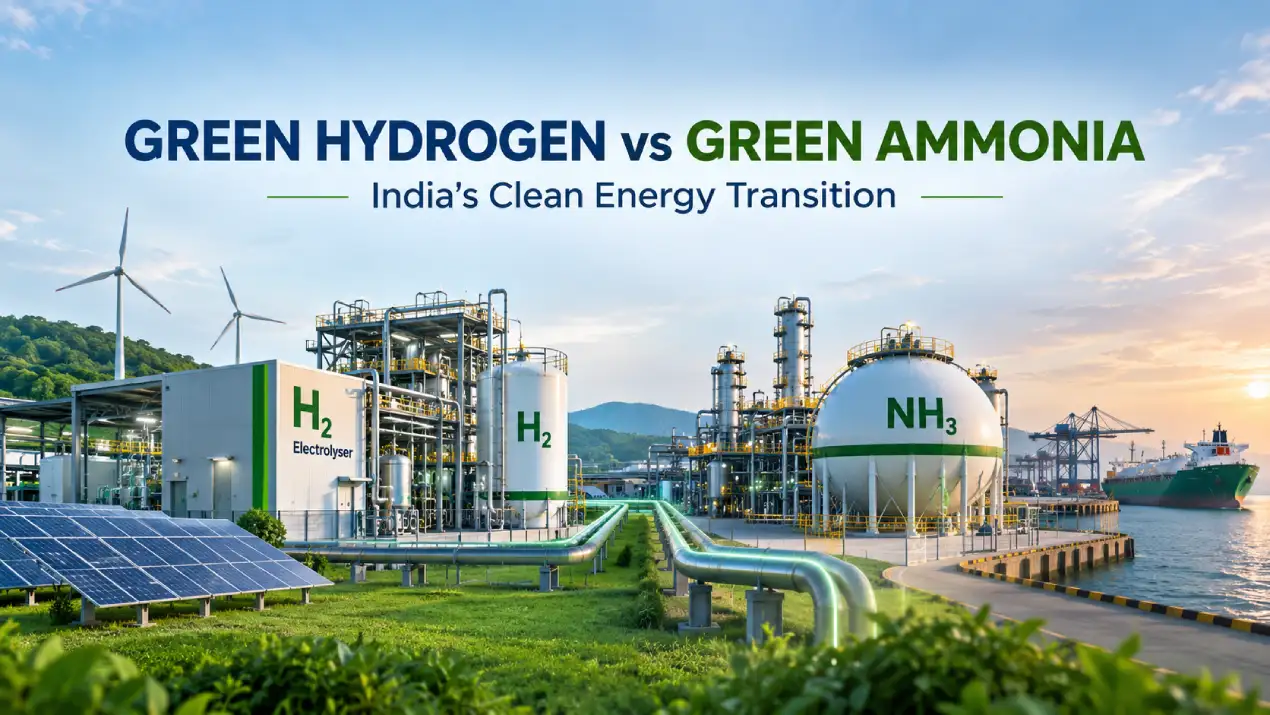
Why Are Green Hydrogen and Green Ammonia Gaining Attention in India?
India’s clean energy transition is creating demand for low-carbon fuels and industrial feedstocks. Two solutions attracting growing attention are green hydrogen and green ammonia. Both can help industries reduce dependence on fossil fuels, but they differ in production, storage, transportation and end-use applications.
The key difference is that green hydrogen is produced using renewable electricity to split water, while green ammonia is made by combining green hydrogen with nitrogen. Hydrogen can be used directly in industrial processes, whereas ammonia serves as a chemical feedstock, a potential fuel and a more transportable hydrogen derivative.
With India’s National Green Hydrogen Mission and increasing industrial procurement commitments, both are becoming important to the country’s emerging green molecules economy.
What Is Green Hydrogen and How Is It Produced?
Green hydrogen is produced through electrolysis, a process that uses renewable electricity from solar or wind power to split water into hydrogen and oxygen.
The production process involves:
- Renewable power: Solar and wind energy supply electricity to the production facility.
- Water treatment: Water is treated to meet electrolyser requirements.
- Electrolysis: An electrolyser separates water into hydrogen and oxygen.
- Purification and compression: Hydrogen is processed for storage, transportation or industrial use.
Green hydrogen can replace fossil-based hydrogen in petroleum refining and fertiliser manufacturing. It also has emerging applications in steel production, heavy-duty transport and shipping.
India’s Green Hydrogen Standard specifies an emissions threshold of no more than 2 kg CO₂ equivalent per kg of hydrogen, measured on a well-to-gate basis over a 12-month average.
What Is Green Ammonia and How Is It Produced?
Green ammonia is produced by combining green hydrogen with nitrogen, generally through the Haber-Bosch process.
Nitrogen is separated from air, while green hydrogen is generated using renewable electricity. These inputs are then combined under controlled conditions to produce ammonia (NH₃).
Green ammonia has several important applications:
- Fertiliser production: Used as a feedstock for nitrogen-based fertilisers.
- Shipping: Being developed as a potential low-carbon marine fuel.
- Power generation: Can be considered for ammonia co-firing in suitable thermal power plants.
- Energy transportation: Can carry hydrogen in a chemical form that is comparatively easier to store and transport at scale.
India notified its Green Ammonia Standard in February 2026, setting a maximum emission threshold of 0.38 kg CO₂ equivalent per kg of ammonia across the specified production and handling stages.
Green Hydrogen vs Green Ammonia: What Are the Key Differences?
| Parameter | Green Hydrogen | Green Ammonia |
|---|---|---|
| Chemical formula | H₂ | NH₃ |
| Production | Renewable-powered water electrolysis | Green hydrogen combined with nitrogen |
| Primary use | Industrial feedstock and energy carrier | Chemical feedstock, fuel and hydrogen carrier |
| Major industries | Refining, steel, fertilisers and mobility | Fertilisers, shipping and power generation |
| Storage | Requires specialised high-pressure or cryogenic systems | Can be stored as a liquid using established ammonia-handling systems |
| Transportation | Requires specialised infrastructure | Benefits from established chemical transport and shipping infrastructure |
| Processing | Electrolysis, purification and compression | Hydrogen production, nitrogen separation and ammonia synthesis |
The two are complementary solutions rather than direct competitors. Green hydrogen is suitable when an industrial process requires hydrogen directly, while green ammonia is useful when ammonia itself is required or when hydrogen needs to be transported in derivative form.
Why Is India’s Green Hydrogen and Ammonia Market Growing?
The Government of India’s National Green Hydrogen Mission, approved with an initial outlay of ₹19,744 crore, aims to establish India as a global hub for green hydrogen production, utilisation and exports.
Recent government developments highlight the growing scale of this market:
- Green hydrogen production capacity: Incentives have been awarded for 8.62 lakh tonnes per annum of green hydrogen production capacity across 18 companies.
- Electrolyser manufacturing: Incentives have been awarded to 15 companies for 3,000 MW per annum of electrolyser manufacturing capacity.
- Green ammonia procurement: SECI’s procurement process has facilitated green ammonia supply arrangements for fertiliser units, creating long-term demand visibility for producers.
- Growing industrial demand: By October 2026, Indian companies had signed 23 green hydrogen offtake agreements representing approximately 5.56 lakh tonnes per annum of hydrogen-equivalent supply commitments.
- Export opportunities: More than 70% of these reported offtake commitments are earmarked for exports, indicating opportunities in international clean-fuel markets.
These developments are helping build a domestic ecosystem spanning renewable energy, electrolyser manufacturing, hydrogen production, ammonia synthesis and industrial consumption.
What Are the Cost and Infrastructure Differences?
The cost of green hydrogen is primarily influenced by renewable electricity prices, electrolyser efficiency, equipment investment, water availability, plant utilisation and storage requirements.
Green ammonia involves additional processes, including nitrogen separation and ammonia synthesis. These increase processing requirements but provide advantages in storage and transportation through established ammonia infrastructure.
Industrial developers must evaluate:
- Availability and cost of renewable electricity.
- Electrolyser technology and operating efficiency.
- Hydrogen and ammonia storage facilities.
- Pipeline, port and transportation infrastructure.
- Industrial demand and long-term offtake agreements.
- Safety, certification and emissions compliance.
There is no universal cost advantage between the two. The economics depend on the intended application, project location, technology and infrastructure.
Which Is Better for Different Indian Industries?
The choice between green hydrogen and green ammonia depends on the industrial requirement.
- Fertiliser industry: Green ammonia can replace conventional ammonia as a feedstock in suitable manufacturing processes.
- Petroleum refineries: Green hydrogen can replace grey hydrogen used in refining operations.
- Steel manufacturing: Green hydrogen can support lower-carbon iron production through direct reduction processes.
- Shipping and ports: Green ammonia is being explored as an alternative marine fuel and an export-oriented energy carrier.
- Power generation: Green ammonia can be evaluated for co-firing applications, subject to technical and regulatory requirements.
For industrial decision-makers, the selection should consider fuel requirements, production economics, infrastructure readiness and long-term supply security.
How Jakson Green Is Supporting India’s Green Molecules Transition?
As India expands its renewable energy ecosystem, integrated energy solutions will play an important role in developing green hydrogen and green ammonia infrastructure.
Jakson Green is developing capabilities across green hydrogen production, green ammonia and associated renewable energy infrastructure. Its solutions include renewable-powered electrolysis, hydrogen-to-ammonia conversion and Green EPC capabilities for green molecule projects.
These capabilities support the development of infrastructure required for industrial decarbonisation and the wider adoption of renewable fuels.
Explore Jakson Green’s solutions: https://jakson-green.com/key-solutions/
Green hydrogen and green ammonia are emerging as important pathways for India’s industrial energy transition. Green hydrogen offers a direct alternative to fossil-based hydrogen in industrial processes, while green ammonia creates opportunities in fertiliser manufacturing, shipping, power applications and international energy trade.
With the National Green Hydrogen Mission, growing offtake agreements and investments in domestic manufacturing, India is building the foundations for a green molecules economy.
For businesses, the opportunity lies in identifying the right application, securing renewable energy, developing reliable infrastructure and establishing commercially viable supply arrangements.
Frequently Asked Questions (FAQs)
1. What is the main difference between green hydrogen and green ammonia?
Green hydrogen is produced by splitting water using renewable electricity. Green ammonia is produced by combining green hydrogen with nitrogen. Hydrogen is used directly in industrial processes, while ammonia is used as a chemical feedstock, fuel and hydrogen carrier.
2. Is green ammonia made from green hydrogen?
Yes. Green ammonia is produced using green hydrogen and nitrogen, generally through the Haber-Bosch process.
3. What is the National Green Hydrogen Mission in India?
It is a government initiative with an initial outlay of ₹19,744 crore. It aims to develop at least 5 million metric tonnes of annual green hydrogen production capacity by 2030.
4. Which industries use green hydrogen?
Green hydrogen has applications in petroleum refining, fertiliser manufacturing, steel production, heavy-duty transport and shipping.
5. Why is green ammonia easier to transport than hydrogen?
Ammonia can be liquefied and transported using established chemical storage and shipping infrastructure. Hydrogen requires specialised high-pressure or cryogenic storage systems.
6. Is green ammonia used in fertiliser manufacturing?
Yes. Ammonia is an important feedstock for nitrogen-based fertilisers. Green ammonia can replace conventional ammonia in suitable production processes.
7. What affects the cost of green hydrogen?
Renewable electricity prices, electrolyser costs, efficiency, operating hours, water treatment, compression and storage are major cost factors.
8. What is the future of green hydrogen and green ammonia in India?
Their growth will depend on renewable energy availability, industrial demand, government incentives, infrastructure development, technology costs and long-term offtake agreements.