How Is Compressed Biogas Changing India’s Energy Landscape?
India’s energy transition is expanding beyond solar and wind power. As the country looks to diversify its energy sources, reduce dependence on imported fuels and improve waste management, Compressed Biogas (CBG) is emerging as an important part of the clean energy ecosystem.
CBG converts organic waste such as agricultural residue, cattle dung, food waste, press mud and segregated municipal waste into renewable gaseous fuel. This creates an opportunity to address two challenges together: managing organic waste and producing domestic energy.
The sector has gained fresh momentum with the Government of India’s ₹23,731 crore GOBARdhan scheme, approved in August 2026 and launched on 1 October 2026. The ten-year framework aims to accelerate CBG production through financial assistance, assured offtake, pricing support and infrastructure development.
What Is Compressed Biogas and How Is It Produced?
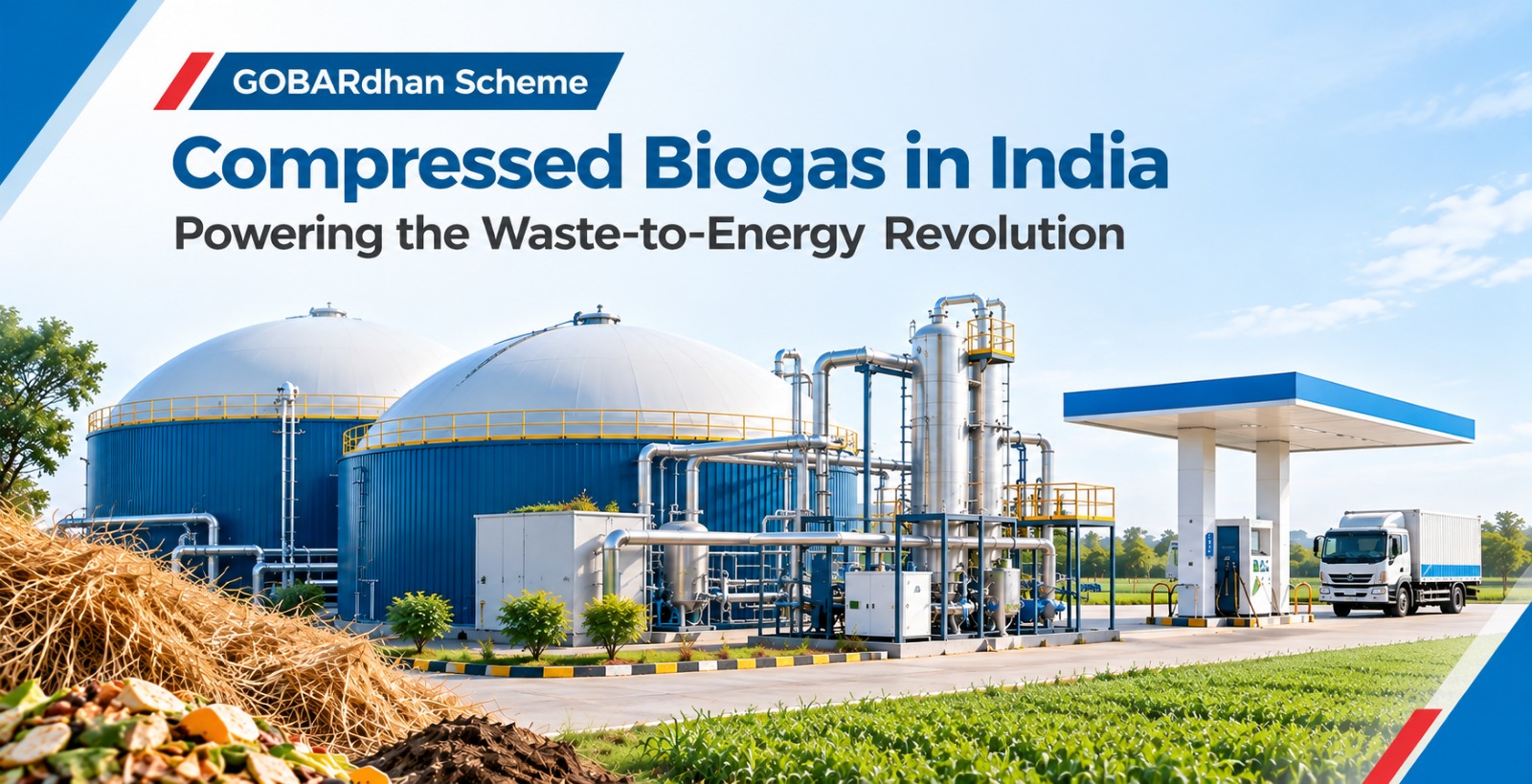
Compressed Biogas is a renewable fuel produced through anaerobic digestion, a biological process in which microorganisms break down biodegradable materials in the absence of oxygen.
The process involves several stages:
• Feedstock collection: Organic waste, agricultural residue, cattle dung and other biodegradable materials are collected.
• Pre-treatment: The feedstock is prepared to ensure efficient digestion.
• Anaerobic digestion: Organic matter is converted into raw biogas.
• Gas purification: Impurities such as carbon dioxide and hydrogen sulphide are removed.
• Compression: The purified gas is compressed to produce CBG for storage, transportation and use.
CBG has properties comparable to conventional compressed natural gas (CNG) and can be used in suitable transport and industrial applications. The process also generates digestate, which can be processed into fermented organic manure.
Why Is CBG Gaining Momentum in India?
India’s growing energy requirements and significant availability of organic waste create an opportunity for the development of a domestic bioenergy industry.
CBG can contribute in several ways:
• Energy security: Domestic production can help diversify India’s fuel supply and reduce reliance on imported natural gas.
• Agricultural waste management: Crop residue and other biomass can be converted into productive resources.
• Cleaner urban waste management: Segregated organic municipal waste can be processed into renewable fuel.
• Rural economic opportunities: Feedstock collection, transportation and plant operations can create income and employment opportunities.
• Circular economy: CBG production generates both renewable fuel and organic manure, supporting resource recovery.
This makes CBG more than an alternative fuel. It connects agriculture, waste management, energy production and rural development.
GOBARdhan Scheme: A Major Push for India’s CBG Industry
A significant development for India’s bioenergy sector is the ₹23,731 crore GOBARdhan scheme, approved by the Union Cabinet on 6 August 2026 and formally launched on 1 October 2026.
The scheme will operate from FY 2026–27 to FY 2035–36 and aims to increase domestic CBG production nearly ten-fold.
Its framework focuses on six key areas:
• Assured offtake: Procurement through City Gas Distribution (CGD) entities to provide a more predictable market for CBG producers.
• Stable pricing: A government-backed administered price framework of ₹2,110 per MMBTU.
• Capital assistance: Eligible greenfield projects can receive assistance of up to ₹2 crore per tonne per day (TPD) of installed capacity.
• Pipeline infrastructure: Support for connecting CBG plants with CGD networks and trunk pipelines.
• Credit guarantee: Improved access to institutional finance, particularly for eligible MSME-based projects.
• Ecosystem development: Support for feedstock aggregation, technology adoption, organic manure processing and district-level planning.
The scheme also establishes a CBG blending obligation for CNG (transport) and domestic PNG segments:
• 3% in FY 2026–27
• 4% in FY 2027–28
• 5% from FY 2028–29 onwards
These measures are intended to strengthen demand visibility and improve the commercial viability of CBG projects.
How CBG Supports India’s Circular Economy
One of the biggest opportunities for CBG lies in creating value from locally available organic resources.
Agricultural residue, cattle dung, food waste and industrial organic by-products can become feedstock for CBG plants. Instead of being discarded, these materials can be converted into renewable fuel.
The resulting digestate can also be processed into fermented organic manure, creating another useful output for agriculture.
Organic Waste → Feedstock Processing → Anaerobic Digestion → Biogas Purification → Compression → CBG
The residual digestate is processed into organic manure and returned to agricultural use. This approach can support better waste utilisation, additional rural income opportunities and more resource-efficient energy production.
What Are the Challenges in Scaling CBG Projects?
Despite growing policy support, successful CBG development depends on addressing several operational and commercial challenges.
• Feedstock availability: Consistent access to suitable biomass is essential for uninterrupted plant operations.
• Logistics and aggregation: Collection, transportation and storage require efficient supply-chain management.
• Project economics: Capital costs, operating expenses and plant utilisation influence financial viability.
• Technology performance: Efficient digestion, purification and compression are important for consistent gas quality.
• Market connectivity: Reliable access to CGD networks and offtake arrangements is necessary to deliver CBG to end users.
Addressing these challenges through integrated project planning, appropriate technology and strong local partnerships will be important for scaling the industry.
The Role of Jakson Green in India’s CBG Transition
As India’s renewable energy landscape expands, Jakson Green is extending its focus beyond conventional renewable power into emerging clean energy solutions.
Its Compressed Bio-Gas business focuses on developing and operating projects that convert biodegradable feedstock, including agricultural residues, press mud, food waste and segregated municipal solid waste, into renewable gaseous fuel.
Through anaerobic digestion, gas purification and compression technologies, Jakson Green aims to contribute to the development of CBG infrastructure and India’s wider waste-to-energy ecosystem.
Explore Jakson Green’s Compressed Bio-Gas solutions: https://jakson-green.com/key-solutions/
Compressed Biogas presents an opportunity to connect India’s waste management priorities with its clean energy ambitions. With the GOBARdhan scheme, rising CBG blending obligations and support for infrastructure development, the sector is entering an important phase of growth.
Realising this potential will require reliable feedstock supply chains, efficient technologies, commercially viable projects and collaboration across the energy and agriculture sectors.
By converting organic waste into renewable fuel and valuable agricultural inputs, CBG can play a meaningful role in building a more diversified, resource-efficient and sustainable energy future for India
Frequently Asked Questions (FAQs)
1. How is CBG different from conventional biogas?
Biogas is the raw gas produced through anaerobic digestion. CBG is purified to remove impurities and carbon dioxide, then compressed for storage, transportation and use as a fuel.
2.How is CBG different from conventional biogas?
Biogas is the raw gas produced through anaerobic digestion. CBG is purified to remove impurities and carbon dioxide, then compressed for storage, transportation and use as a fuel.
3. What is the GOBARdhan scheme?
GOBARdhan is a ₹23,731 crore Central Sector Scheme launched in October 2026 to accelerate India’s CBG industry through offtake assurance, pricing support, capital assistance, pipeline infrastructure and credit support.
4. What is India’s CBG blending obligation?
The notified blending obligation for CBG in CNG (transport) and domestic PNG segments is 3% in FY 2026–27, 4% in FY 2027–28 and 5% from FY 2028–29 onwards.
5. What raw materials are used to produce CBG?
Common feedstocks include agricultural residues, cattle dung, press mud, food waste and segregated municipal organic waste.
6. Can CBG replace CNG?
CBG has properties comparable to conventional CNG and can be used as a renewable alternative in suitable applications, subject to applicable quality and safety standards.
7. What is the by-product of CBG production?
The digestion process produces digestate, which can be processed into fermented organic manure for agricultural applications.
8. What are the benefits of setting up a CBG plant in India?
CBG plants can support renewable fuel production, organic waste management, agricultural resource utilisation and rural employment. Eligible projects may also access support under the applicable GOBARdhan framework.