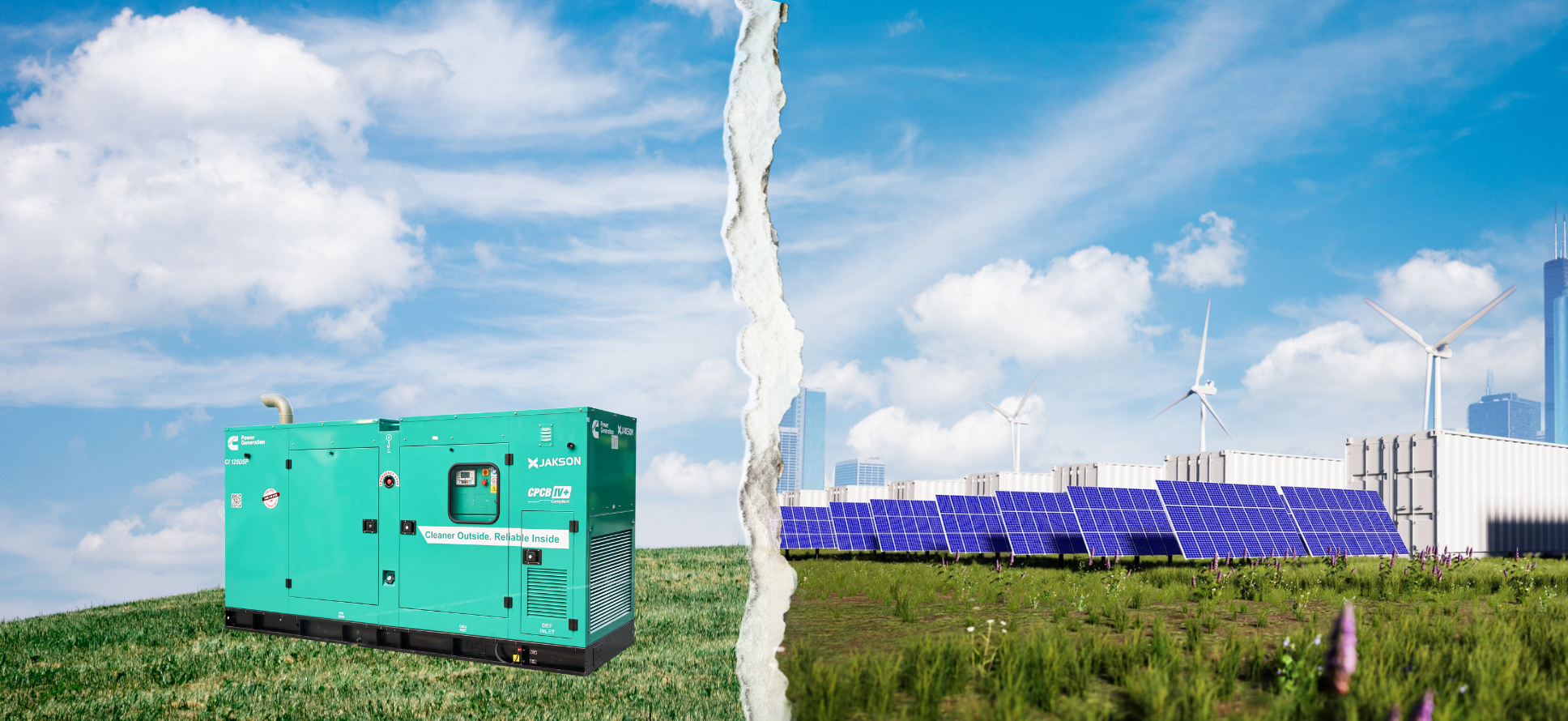
Power backup decisions are shaped by downtime risk, load variability, and the operational cost of failure. This is where the comparison between diesel gensets vs renewable backup becomes critical, and why it sits squarely within Jakson’s power and energy solutions portfolio, which spans conventional generation, renewables, and integrated system design.
Jakson specialises in diesel generator sets, renewable energy systems, and hybrid energy systems, allowing for a comprehensive approach to backup power. Instead of viewing diesel and renewable energy as separate power backup solutions, we consider backup power an infrastructure decision that needs to operate reliably under actual conditions.
Diesel Gensets: Immediate Reliability and Control
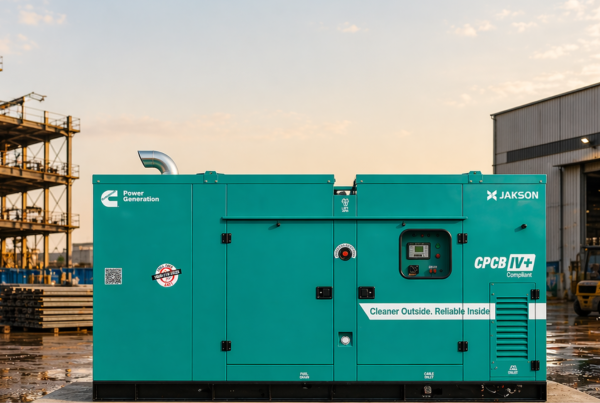
Diesel gensets remain one of the most established backup power solutions, particularly where response time and load certainty are critical. Their primary advantage lies in their ability to deliver predictable output immediately when grid power fails, independent of weather or generation cycles.
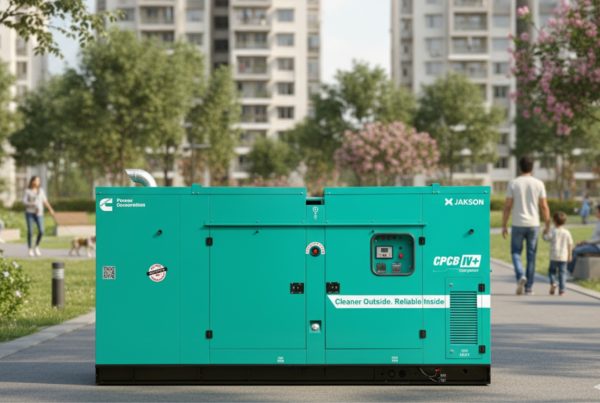
For industrial operations, infrastructure projects, and facilities with high or fluctuating loads, diesel gensets function as a reliability anchor. Their controllability and consistency make them suitable for environments where power interruption directly affects operations.
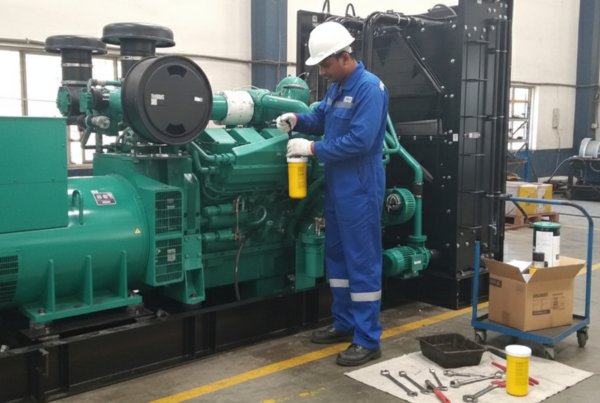
Jakson’s diesel gensets are designed for such high-reliability applications, supporting backup requirements where grid instability cannot be absorbed by renewable systems alone. At the same time, diesel-based backup introduces considerations around fuel logistics, operating costs, and emissions, factors that become more relevant as backup usage increases.
Renewable Backup: Reducing Dependence on the Grid
Renewable backup systems, most commonly solar-based, address reliability by reducing reliance on centralised grid supply. Instead of reacting only during outages, they generate power locally and offset grid consumption on a continuous basis.
When combined with energy storage, renewable backup can support predictable loads and contribute to long-term operating efficiency. However, renewable systems are inherently variable and depend on generation conditions and storage capacity.
Through its renewable and distributed energy capabilities, Jakson enables solar-based backup solutions that are designed as part of a broader power strategy. This ensures renewables contribute to reliability without being positioned as a single-source replacement for backup power.
Diesel Gensets vs Renewable Backup: A Practical Comparison
The comparison between diesel gensets vs renewable backup is often oversimplified. In reality, each technology delivers reliability differently.
Diesel gensets assure mechanical generation and fuel availability. Renewable systems, on the other hand, improve resilience by decentralising generation and lowering grid exposure. One prioritises immediacy; the other prioritises long-term efficiency.
This distinction is why decisions framed as solar vs diesel generatorsfrequently miss the operational nuance required for reliable power planning.
Hybrid Energy Systems: Coordinated Reliability
Hybrid energy systems bridge the gap between diesel and renewable backup. By integrating diesel gensets, renewable generation, and battery storage, hybrid systems allow power to be managed dynamically based on load demand and availability.
Jakson’s hybrid energy systems are engineered as coordinated power architectures, not layered solutions. Renewable energy reduces diesel runtime, storage manages variability and transitions, and diesel gensets provide continuity during extended outages or peak demand.
This coordination enables reliability without over-reliance on a single energy source.
Choosing the Right Power Backup Solution
Selecting the right power backup solution depends on operating patterns, outage frequency, and reliability expectations.
Facilities with short but critical outages may prioritise diesel gensets. Sites aiming to reduce grid dependence and operating costs may adopt renewable backup. Locations with complex load profiles or extended outage risk often benefit most from hybrid energy systems.
Jakson’s approach is to align backup power solutions with operational reality, ensuring that technology selection supports continuity rather than introducing new constraints.
Conclusion
The choice between diesel gensets vs renewable backup is not a binary one. Each technology addresses a different dimension of power reliability. Diesel gensets deliver immediate, controllable backup. Renewable systems reduce long-term dependence on centralised power. Hybrid architectures integrate both into a resilient whole.
Jakson’s strength lies in delivering power backup solutions across this entire spectrum. By combining diesel generation, renewable energy, storage, and system engineering, Jakson enables reliable power architectures designed for sustained performance under diverse operating conditions.
FAQ
Yes. Diesel gensets remain essential where immediate and predictable backup power is required.
Not always. Renewable systems work best with storage and are often complemented by diesel in hybrid configurations.
They balance reliability, efficiency, and operational flexibility within a single power system.